Though people say “rocket science” to mean that something is really difficult, some of the basics aren’t so bad. In fact, while “the rocket equation” might be a bit too complicated to comprehend fully before high school, you can still understand the idea now.
The Original Equation
The original version of the rocket equation is named for Russian scientist Konstantin Tsiolkovsky, who published his work in the early 1900s. However, several others independently discovered such these relations between variables. Other than William Moore in 1810, the famed physicists and rocket engineers Robert Goddard and Hermann Oberth also developed such models.
The common version can be written as follows:Or in terms of words:
Based on the equation, the logic for several rocket design decisions becomes evident. Since it is best to have the highest possible change in velocity (that’s what lets you move in space), you want to maximize the factors of the equation. This includes maximizing the speed at which the exhaust comes out of the rocket engine, which varies between combustion engines, electric engines, and other types of rocket engines. It also means making the “empty” mass of the rocket as small as possible while holding the most fuel. This equation is “ideal,” meaning that it’s a best case scenario and doesn’t account for other factors or forces, like gravity.
There’s one part of this equation you probably don’t recognize, which is the part that says . This refers to the natural logarithm, which is usually something you learn in high school. Knowing the exact specifics aren’t too important, but its graph usually looks like a line that is always increasing but increases slower as you go on. Turn on sources and click here to see a graph. Because the line increases less over time, increasing the ratio between full and empty mass becomes a bit less important as the ratio grows. Still, with our technology, engineers use special materials and designs to try to save every pound or kilogram of mass, as that affects the payload that can be carried significantly.
The Mass Ratio and Mass Fraction
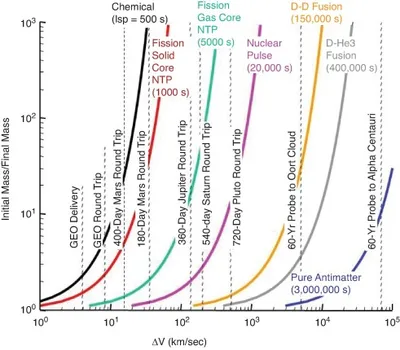
Here, the mass ratio represents how many times heavier the rocket is fueled compared to when it is empty. This relationship explains the chart on the left: for a given (ideal change in velocity), engine types with faster exhaust velocities must have lower mass ratios, and vice versa.
You may also see the term mass fraction, which is the fraction of the total mass of the vehicle that is propellant. This can be simply expressed as the propellant mass over the total mass (in this case, but you may see different notations elsewhere).
The relationship with the mass ratio is shown as follows. Dry mass is shown as :